
Can’t I just buy life insurance instead of paying for SBP?
When we work with service members approaching retirement, one question comes up in almost every planning conversation: “Can’t I just buy life insurance instead of paying for SBP?”
It’s a reasonable question. The Survivor Benefit Plan costs money every month, and term life insurance can look inexpensive by comparison. Anyway, both are ways of protecting a spouse if you die first, right? So why not choose the cheaper one?
Unfortunately, they aren’t the same product, so they don’t solve the same problem. Treating them as substitutes is one of the most common mistakes we see in military retirement planning, and the SBP election is largely irrevocable, so it’s a mistake that’s hard to undo.
This post explains how each one works, where each one shines, where each one falls short, and how to think about using them together.
What the Survivor Benefit Plan Actually Does
Your retired military pay stops when you die. For a spouse who has been relying on that income, that’s a sudden and permanent drop in household income.
SBP is designed to soften that drop. By electing coverage at retirement, you are ensuring that your eligible survivor receives an ongoing income stream for the rest of their life.
How it works:
The benefit: Your spouse receives up to 55% of the retired pay you elect to cover. If you cover your full retired pay, your survivor receives 55% of it each month.
The cost: 6.5% of your covered base amount is deducted from your monthly retired pay. Those premiums are paid with pre-tax dollars, which lowers their effective cost.
Inflation protection: The annuity receives annual cost-of-living adjustments, so its purchasing power is designed to keep pace with rising prices over what could be a very long period.
No health screening: SBP doesn’t require a medical exam or health questions. A retiree with serious health conditions can enroll on the same terms as anyone else.
Paid-up status: After 30 years of premiums and reaching age 70, coverage becomes paid-up and the premiums stop.
Taxes: The annuity is taxable income to the survivor.
A few rules worth knowing:
If a surviving spouse remarries before age 55, the annuity generally stops.
SBP can cover a spouse, dependent children, a former spouse in certain situations, or someone with an insurable interest, and the cost and rules differ for each.
As of 2023, SBP is no longer reduced by VA Dependency and Indemnity Compensation (DIC), so survivors who qualify for both can receive both. If this could apply to your family, review your coverage with a professional.
A married retiree who wants to decline or reduce coverage generally needs the spouse’s written concurrence.
The key idea: SBP is income replacement. It replaces part of the pension that disappears when you die, for as long as your survivor lives.
What Term Life Insurance Actually Does
Term life insurance works very differently from SBP. You pay a premium, which typically stays level for the length of the term. Then, if you die during that term, the policy pays a one-time, lump-sum death benefit to your beneficiary. That benefit is generally income-tax-free.
How it works:
The term: Commonly 10, 15, 20, 25, or 30 years.
The benefit: Surviving spouse receives a lump sum, in an amount you choose, within the limits of what you qualify for.
The cost: Depends on your age, health, the amount, and the length of the term. For healthy people, term premiums can be low, especially when you’re younger.
Health underwriting: You generally have to qualify medically. The older you are and the more health conditions you have, the more expensive coverage becomes, and in some cases it may not be available.
The end date: The coverage ends with the end of the term unless you renew at a much higher premium or convert to a permanent policy, if your policy allows it.
Here’s the part people rarely say out loud: most term life policies never pay a claim. Industry research consistently shows that the large majority of term policies expire without paying a death benefit.
That isn’t a flaw. It’s how the product is designed. You’re buying protection against a specific risk during a specific window of your life: while you’re paying the mortgage, the years your kids are at home, or the stretch before your savings are fully built. If you outlive the term, the risk you were covering has passed, and the policy ends having done its job.
The key idea: term insurance is temporary protection for a temporary need, delivered as a lump sum.
Two Different Tools for Two Different Jobs
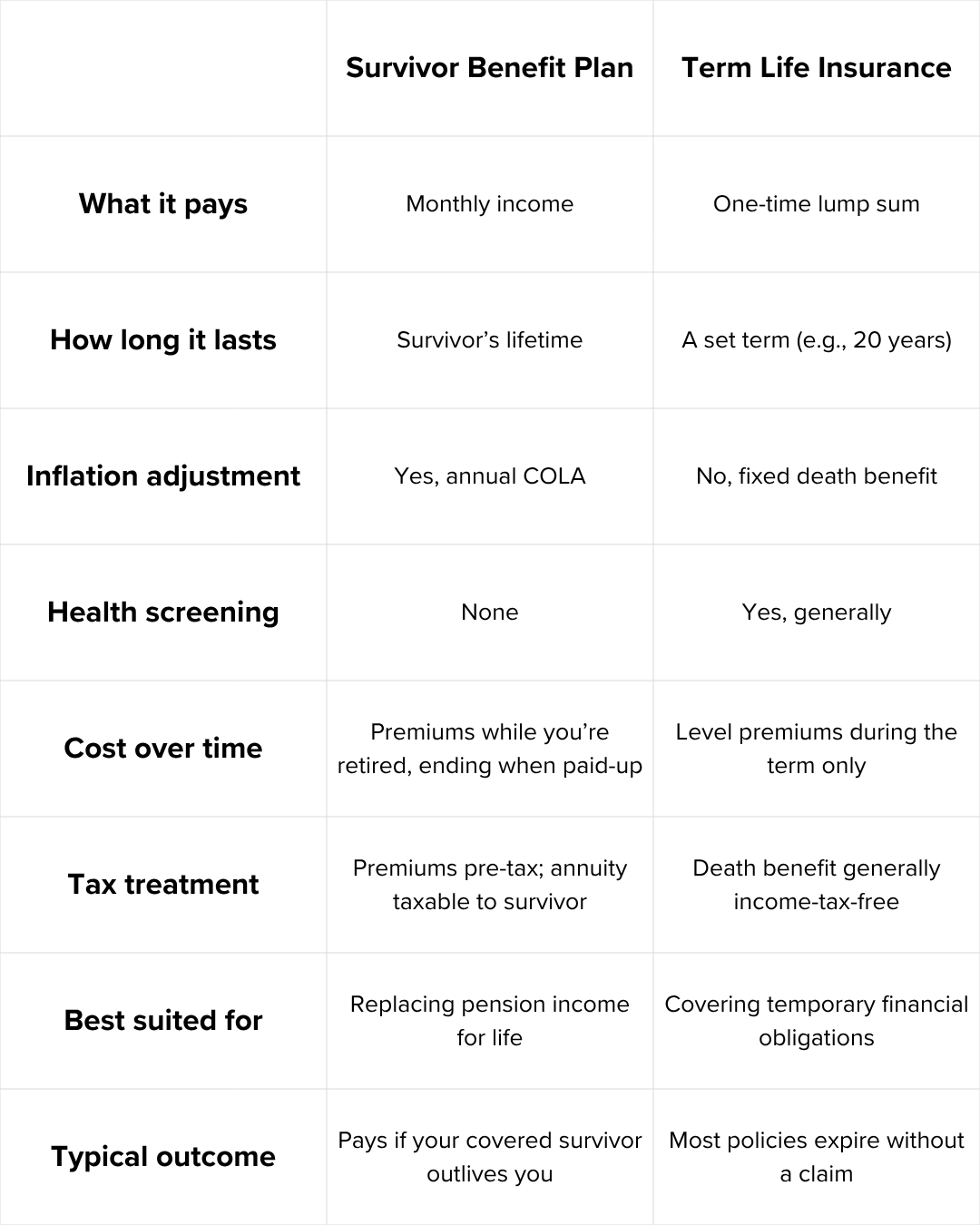
Here’s the comparison side by side:
Neither product is better in the abstract. To truly compare the two options, you need to consider your unique situation. The two policies answer different questions. SBP asks: “How do I keep part of my pension going for my spouse’s entire lifetime?” Term life asks: “How do I cover a financial risk during a defined period?”
Why Term Life Struggles to Replace SBP
Many families explore replacing SBP with term life insurance. And while it can work for some, it’s harder than it looks.
1. The coverage tends to expire when the need is greatest. The need SBP fulfills is lifelong. A 20- or 30-year term bought at age 42 may end when you’re in your 60s or early 70s, just when your spouse is most likely to need income and when new coverage would be hardest and most expensive to obtain.
2. Health can change. Term insurance requires underwriting. If your health changes after retirement, or you have service-connected conditions, replacement coverage later may cost far more or not be available. For SBP, health doesn’t enter the conversation.
3. A lump sum has to do the work of an income stream. Suppose your retired pay is $4,000 per month. Full coverage through SBP costs 6.5% of that, or $260 per month. Then, when the policy pays out, your survivor receives $2,200 per month, adjusted for inflation, for life.
To produce a similar outcome (roughly $26,400 a year) from a lump sum using a conventional 4% withdrawal rule of thumb, a survivor would need something in the neighborhood of $650,000 to $750,000, invested well, withdrawn carefully, and not outlived. This is an illustration only, and actual results depend on markets, taxes, and spending. The SBP annuity doesn’t depend on any external conditions.
4. No built-in inflation adjustment. A fixed death benefit buys less every year. The SBP annuity is adjusted annually.
5. The investment burden shifts to your spouse. A lump sum comes with decisions: where to invest it, how fast to spend it, and how to protect it from mistakes or from bad actors. An annuity simply arrives each month.

Term Life Insurance can be a strong choice to protect your family during higher risk and working years.
Where Term Life Insurance Genuinely Shines
None of these considerations means term life is the weaker product. It is simply suited for a different job. In some cases sometimes it’s the better choice.
Term life insurance is often well-suited for:
Covering a mortgage and other debts during the years they exist.
Protecting young children through the years they depend on you.
Replacing income during your working years, especially during an encore career or while you’re still building savings.
Funding a specific goal, such as a child’s education or a business obligation.
Covering beneficiaries SBP can’t, since SBP only covers specific eligible beneficiaries.
Providing flexibility, since you choose the amount, the term, and the beneficiary.
For some families, usually those with substantial assets, a spouse with their own strong retirement income, or a limited need for lifetime income replacement, declining SBP and relying on other resources can make sense. However, that conclusion should come from modeling your actual numbers, not from comparing premiums alone.
Why “Both” Is Often the Right Answer
For many military families, the strongest plan layers the two:
SBP provides the lifetime, inflation-adjusted income base that replaces part of your pension.
Term life insurance covers the temporary obligations that sit on top of it: a mortgage, children at home, or income gaps during your encore career years.
SGLI or VGLI may play a role during and just after service. SGLI coverage ends after separation and can be converted within limited windows, so it’s important to confirm your deadlines early.
The two products work well together because they cover different parts of the risk. Using term life to replace SBP asks a temporary product to do a lifetime job. Using SBP to cover a 15-year mortgage asks a lifetime product to do a temporary one.
Questions to Work Through Before You Decide
Before you make the SBP election, sit down with your spouse and work through these:
What would my survivor’s income look like without my retired pay? Include Social Security, their own income, and any other assets.
How long could my survivor reasonably need that income? For a younger spouse, that may be several decades.
What other resources exist? Savings, TSP, home equity, life insurance, and a spouse’s own retirement benefits.
What would it cost to replace SBP with private coverage, accounting for the term length, my current health, and what happens when the term ends?
How comfortable would my spouse be managing a lump sum versus receiving a monthly income?
What does the decision look like across the full picture, including Social Security survivor benefits, VA benefits, and my estate plan?
You’ll make this election once, usually at retirement, with a deadline attached. It deserves more consideration than quickly checking a box on an out-processing form.

SBP and term life insurance are not competitors. They’re different tools built for different jobs.
The Bottom Line
SBP and term life insurance are not competitors. They’re different tools built for different jobs. SBP is lifetime, inflation-adjusted income that replaces part of your pension. Term life is a lump sum that covers a temporary need, and most of the time it expires without being used, exactly as designed.
The right answer depends on your family’s specific numbers, your health, your spouse’s situation, and how all of it fits into your larger retirement plan. A fee-only planner who earns no commissions on either product is well-positioned to model both without a thumb on the scale.
For a plain-language guide to the SBP election and the rest of your military retirement decisions, download our free Military Retirement Playbook. And if you’d like to work through your own situation, we’d be glad to help.