Roth TSP vs. Traditional TSP: Which Should You Choose?

The big question with the TSP is how to use it most effectively for your specific situation.
When you enrolled in the Thrift Savings Plan, you made one of the most important financial decisions of your military career. And if you're like most service members, you made it in about 30 seconds; clicking through a benefits enrollment screen without a clear picture of what you were actually choosing.
That's not a criticism. Nobody hands you a guide when you're in-processing. The TSP enrollment form doesn't come with a financial planning seminar. You picked Traditional or Roth, set a contribution percentage, and moved on to the next task.
The good news is that both options are genuinely excellent. The TSP is one of the lowest-cost retirement accounts in existence and it’s available to anyone in uniform at any pay grade. The question isn't whether to use it. The question is how to use it most effectively for your specific situation.
That starts with understanding what you signed up for.
What's the Difference Between Roth TSP and Traditional TSP?
The Roth TSP and Traditional TSP are slightly different versions of the same account: the Thrift Savings Plan. Both retain the same investment fund options, the same contribution limits, and the same employer matching structure under the Blended Retirement System. The difference comes down to one thing: when you pay taxes on your money.
Traditional TSP contributions are pre-tax.
Under the traditional TSP, your contributions come out of your paycheck before taxes are calculated, which reduces your taxable income today. You get a tax break now, but when you withdraw the money in retirement, you’ll pay income taxes on both the contributions and the growth.
Roth TSP contributions are post-tax.
Under the ROTH TSP, your contributions come out after taxes, so there's no immediate tax break. But when you withdraw the money in retirement, it's completely tax-free. The contributions and all the growth come out without a single dollar going to the IRS.
The central question isn't which account saves you more money. It's which account saves you more money at the right time.
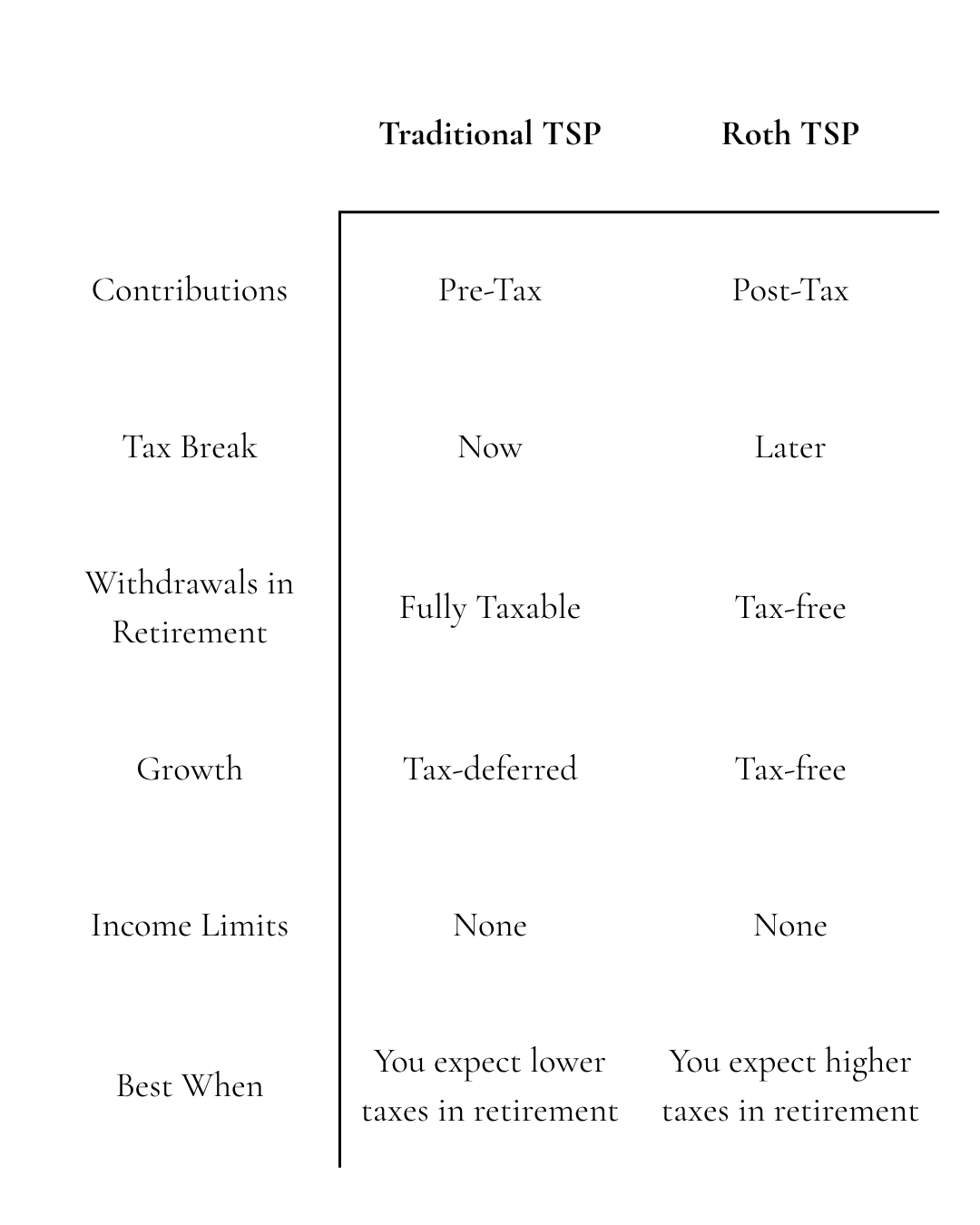
In Summary
Both accounts grow without being taxed along the way. The difference only becomes visible at contribution time and at withdrawal time, which is exactly why this decision deserves more than 30 seconds.
Who Should Choose the Traditional TSP?
The Traditional TSP makes the most sense when you expect your tax rate in retirement to be lower than it is today. If you're paying more in taxes now than you will when you're drawing down your savings, locking in a deduction today is the smarter move.
This tends to apply to:
Senior NCOs and officers in peak earning years.
If you're an E-8, E-9, or an officer at O-5 or above, you're likely in one of the higher tax brackets of your career. Your retirement income, even with a pension, may land in a lower bracket. Taking the tax break now, while your rate is elevated, makes financial sense. However, this scenario also depends on your plans after military retirement. A follow-on career, plus a spouse with a career on the rise, plus a military pension will combine to push your income into an even higher tax bracket. If your post-military plan includes an encore career, start planning taxes now.
Service members approaching retirement within five years.
You're in peak earning territory. The immediate deduction reduces your current tax bill meaningfully, and you have fewer years of compounding growth to benefit from tax-free withdrawal.
Those who need the cash flow.
Pre-tax contributions mean a larger take-home paycheck for the same contribution amount. If you're working to build an emergency fund, pay down debt, or manage a tight household budget during a PCS cycle, the Traditional TSP gives you more financial breathing room today.

The advantages and the costs of Roth contributions are reduced when contributing from combat zones.
Combat zone contributors.
If you're making TSP contributions from combat zone tax-excluded (CZTE) pay, which is already tax-free, both the advantages and the costs of Roth contributions are reduced. Depending on the number of months you are deployed, your taxable income for the year may be dramatically lower. Your contributions aren't taxed either way, so the pre-tax vs. post-tax distinction requires different consideration. Could a boost to your cash flow serve your bigger planning goals? Help you save for a down payment on a house? Will making pre-tax contributions to your TSP during months you are not deployed help you qualify for refundable tax credits? We can help you answer these questions and more, so you make the most of your time down range.
Service members planning to retire in a state with no income tax.
States like Florida, Texas, Nevada, and Washington have no state income tax. If you plan to retire there, your overall retirement tax burden may be low enough that the Traditional TSP's deferred taxation works in your favor. Retirement location matters.
Who Should Choose the Roth TSP?
The Roth TSP makes the most sense when you expect your tax rate in retirement to be higher than it is today. And for many military members, especially those earlier in their careers, that's a realistic expectation.
Junior enlisted and early-career service members.
If you're an E-3 or E-4 with 3–5 years of service, you're likely in one of the lowest tax brackets of your life. Paying taxes on your contributions now, while your rate is low, locks in tax-free growth for decades. A 25-year-old who contributes to a Roth TSP for 20 years of service and then lets that balance grow in a Roth IRA for another 20 years could accumulate significant completely tax-free wealth by retirement age.
Service members who expect a higher tax rate in retirement.
This one surprises people, but it's worth thinking through carefully. Military retirees often have multiple income streams: a pension, TSP or IRA withdrawals, Social Security, and potentially an encore career salary or business income. Stack all of those together and your post military retirement tax bracket may be higher than you'd expect, making tax-free Roth withdrawals extremely valuable.
Anyone who values income flexibility in retirement.
Tax-free income doesn't count toward the income thresholds that determine how much of your Social Security is taxed, whether you pay Medicare surcharges, or what bracket you land in. Having a pool of Roth money to draw from gives you meaningful control over your taxable income in retirement.
Here's the one fact that makes the Roth TSP especially powerful
it has no income limits. The Roth IRA, the civilian version of this account, phases out for high earners above certain income thresholds. The Roth TSP has no such restriction. A colonel with 28 years of service can contribute to Roth TSP just as easily as an E-2 in their first year. This makes Roth TSP one of the most accessible tax-free savings tools available at any pay grade.

Splitting contributions between Traditional and Roth TSP is the often the most strategic approach.
Can You Do Both?
Yes! For many service members, splitting contributions between Traditional and Roth TSP is the most strategic approach.
You can direct any percentage of your contributions to Traditional, any percentage to Roth, and adjust the split at any time. The only rule is that your combined contributions must stay within the annual limit: $24,500 in 2026 for most service members, $32,500 for those age 50 and older, and $35,750 for those ages 60–63 under the SECURE 2.0 enhanced catch-up provision.
Splitting contributions is a strategy called tax diversification, and it's worth understanding. Nobody knows with certainty what tax rates will look like 20 years from now. Congress can change tax laws. Your income situation will evolve. Having both pre-tax and post-tax retirement savings gives you flexibility to manage your taxable income in retirement by drawing from whichever account makes more sense each year.
If you're genuinely unsure which option fits your situation, a 50/50 split is a reasonable starting point. You're not locked in, and you can adjust your allocation through your TSP account settings at any time.
And while you're reviewing your Traditional vs. Roth allocation, this is also a good time to revisit your contribution rate overall. Many service members set their contribution percentage years ago, often at the minimum needed to capture the BRS match, and have never adjusted it as their pay has increased. If you've received promotions, re-enlistment bonuses, or special pay increases and haven't increased your TSP contributions proportionally, you're leaving compounding time on the table.
What Happens to Your TSP When You Separate or Retire?
Your TSP account doesn't disappear when you leave service. You have several options at the end of service, and the choice you make here matters as much as the Roth vs. Traditional decision did when you enrolled.
Leave it in the TSP
This is a completely valid choice and often an underrated one. The TSP offers some of the lowest expense ratios of any retirement account in existence. You lose the ability to make new contributions, but the account continues to grow. If you're many years from retirement and don't need the broader investment options an IRA provides, leaving it in place can be the right call.
Roll Traditional TSP into a Traditional IRA
This opens up a wider range of investment options and gives you more flexibility for distributions and estate planning. There's no tax event if done correctly via a direct rollover.
Roll Roth TSP into a Roth IRA
This preserves the tax-free status of your contributions and growth and comes with an important added benefit. Roth IRAs have no required minimum distributions (RMDs) during the account owner's lifetime, while Roth TSP does. Rolling to a Roth IRA eliminates that RMD obligation, giving you more control over when and how you access your money.

Never mix Traditional and Roth in the same rollover to avoid a taxable even and significant tax bill.
Two rules you must follow:
First, never mix Traditional and Roth in the same rollover. Rolling Traditional TSP funds into a Roth IRA (or vice versa) creates a taxable event that can result in a significant and unexpected tax bill. They must be rolled separately into matching account types.
Second, always request a direct rollover. Never accept a check made out to you personally. The moment that check is in your hands, a 60-day window opens and if you miss it, the IRS treats the distribution as income, triggering taxes and a potential 10% early withdrawal penalty.
One more detail that often gets missed
If you made contributions from Combat Zone Tax Excluded (CZTE) pay, those funds have special tax treatment that must be preserved in the rollover process. Getting this wrong can cost you the tax-free status those contributions earned. This is one of those areas where working with an advisor who understands military finances, not just general financial planning, makes a meaningful difference.
How to Make This Decision
The central question is this: do you expect your tax rate to be higher or lower in retirement than it is today?
If higher in retirement → Roth TSP
If lower in retirement → Traditional TSP
If uncertain → split your contributions for tax diversification
Additional factors worth considering: your state's tax treatment of military retirement income, whether you plan an encore career after service, how many income sources you'll have in retirement (pension, Social Security, rental income, business revenue), and how many years of compounding growth remain before you plan to draw on the account.
There's no universal right answer. The best choice for a junior officer early in their career looks completely different from the best choice for a senior NCO approaching retirement. What matters most is that you make this decision intentionally, not by default.
The Bottom Line
The TSP is one of the most powerful wealth-building tools available to anyone in uniform. It has low fees, automatic contribution mechanics, and depending on your enrollment date, government matching contributions that represent a guaranteed return on your savings. Whether you choose Traditional, Roth, or a combination of both, the most important thing is that you're using it fully and reviewing it regularly.
If you'd like to go deeper on TSP strategy, pension decisions, Survivor Benefit Plan elections, and what to do with your TSP after separation, our free Military Retirement Playbook covers all of it in plain language.